Insights and Analysis
EU-UK Spotlight: Renewables, trade, and the global supply chain
.jpg)

The revision of the pharmaceutical legislation in the European Union is close to final, and the new legal framework is expected to be adopted by fall of 2026. Although a 24-month transition period is applicable to most provisions of the new pharmaceutical legislation, some provisions will apply sooner. Innovators should start planning their regulatory data protection (“RDP”) strategically to secure incentives and optimise timelines.


In 2023 the European Commission proposed the most significant reform in over 20 years, replacing Directive 2001/83/EC and Regulation (EC) No 726/2004. The pharmaceutical law package, or EU General Pharmaceutical Law, aims to ensure safe, effective and affordable access to medicinal products, strengthen supply security and create an innovation-friendly environment for R&D and manufacturing in Europe, to name a few.
After the Parliament and Council adopted their positions and trilogue negotiations were concluded, the final text was agreed and published on 6 March 2026.
The next step would be the formal adoption and entry into force of the text, which are expected in fall of 2026, with publication in the Official Journal of the European Union to follow. The agreed text is expected to be adopted unchanged. Therefore, companies can start planning now.
The most prominent and debated changes are the changes to RDP. Under the current regulatory framework companies enjoy 8 years of data protection following marketing authorisation in which generics and biosimilars cannot refer to the data in the marketing authorisation dossier of the innovator’s reference medicinal product when applying for an MA, followed by an additional period of 2 years of market protection during which generic or biosimilar marketing authorisations may be applied for, but during which such products may not be placed on the market. Market protection can currently be extended with an additional year if one (or more) therapeutic indication(s) that represent a significant clinical benefit is/are authorised within the first 8 years of the initial marketing authorisation.
This is set to change under the new legislation. The baseline of 8+2 years is reduced to 8+1 years. Conditional extensions are introduced, potentially resulting in longer overall protection, but bringing uncertainty and complexity. RDP may potentially even be reduced if not complied with the newly introduced launch mechanism.
Potential extensions apply when, in short:
With a view to facilitate access to medicinal products, Member States may within one year from marketing authorisation request marketing authorisation holders to place the product on the market and supply in sufficient quantities for the need of patients in that Member State. For this purpose, the Member State may request specific actions, such as the submission of a valid pricing and reimbursement application. If marketing authorisation holders do not comply, within 3 years after a Member State submitted its launch request, market exclusivity does not apply in that Member State. Launch of generic or biosimilar medicinal products is then possible in that Member State directly after expiry of the 8-year RDP period.
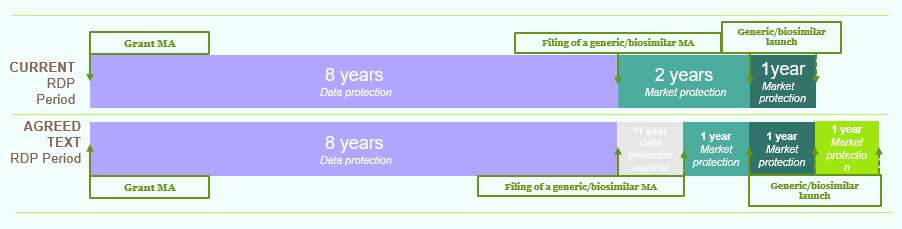
Under the new legislation, marketing authorisation holders could, in principle, obtain an additional 12 months of data protection by use of a transferrable antimicrobial voucher. This voucher will be initially granted on request to marketing authorisation holders of priority antimicrobials, in an effort to combat antimicrobial resistance in the EU.2 However, only five vouchers will be available in total and given the requirements for receipt and use of the voucher, including the exclusion of blockbuster products due to a cap on annual gross sales for the product concerned, practical use of these vouchers remains uncertain and is expected to be rare.
The new pharmaceutical legislation is expected to become applicable in fall 2028 after the transition period. Marketing authorisation applications submitted and pending before the end of the transition period shall be completed under the current regime and RDP will apply to medicinal products authorised subsequently, as under the current regime. Conditional extensions under the new regime are not applicable to these applications.
Innovators should note that Member States can start making launch‑mechanism requests 12 months after entry into force (expected from fall 2027) for products authorised after entry into force (expected fall 2026). Preparation for launch readiness in key Member States may be advised to protect market exclusivity.
For any medicinal products currently in the pipeline, it should be considered whether marketing authorisation application will be submitted in the EU under the current regime (i.e. before fall 2028) or under the new regime (i.e. after fall 2028).
Potential strategic steps to be considered for marketing authorisation applications that are expected to be submitted from fall 2028 are:
Strategy is highly dependent on the specific product and timelines at hand. Reach out to the authors of this article or the Hogan Lovells attorneys with whom you regularly work, to discuss what the new legislation means for your products and how to optimise incentives and timelines.
Authored by Hein van den Bos and Julia Mischie.
References
1 The product shall be considered addressing an unmet medical need if at least one of its therapeutic indications relates to a life threatening or severely debilitating disease and there is no medicinal product authorised in the EU for the disease, or the use of the product for the disease results in clinically relevant improvement in efficacy, or in safety with at least comparable efficacy, in comparison with existing medicinal products or other methods of diagnosis, prevention or treatment authorised in the EU. Designated orphan medicinal products shall be considered as addressing an unmet medical need.
2 ‘Priority antimicrobial' means an antimicrobial that addresses a multi-drug-resistant organism, of which the preclinical and clinical data demonstrate a significant clinical benefit with respect to antimicrobial resistance and it has at least one of the following characteristics: (i) its mechanism of action is distinctly different from that of an authorised antimicrobial in the EU, or (ii) it contains a new active substance that when used either alone or in combination with other active substances addresses a serious or life-threatening infection.